

Dispatch 032 - Continuity
Deep Time, The Causal World and the End of Surface Civilization

On the Sovereign Custody of Deep Time
Continuity is the longest responsibility a nation carries.
It outlives leaders, institutions, borders, and eras. It is the quiet architecture beneath every civilization- the unbroken duty to maintain coherence across generations while the ground shifts beneath them.
Human history can be read as a progression of attempts to steady the future: each expanding the time horizon, each illuminating a deeper substrate of the world that shapes us.
Continuity is not merely a value- it is a geometry of endurance, inherited, renewed, and governed.
I. The Priesthood of Time
Observation as Governance
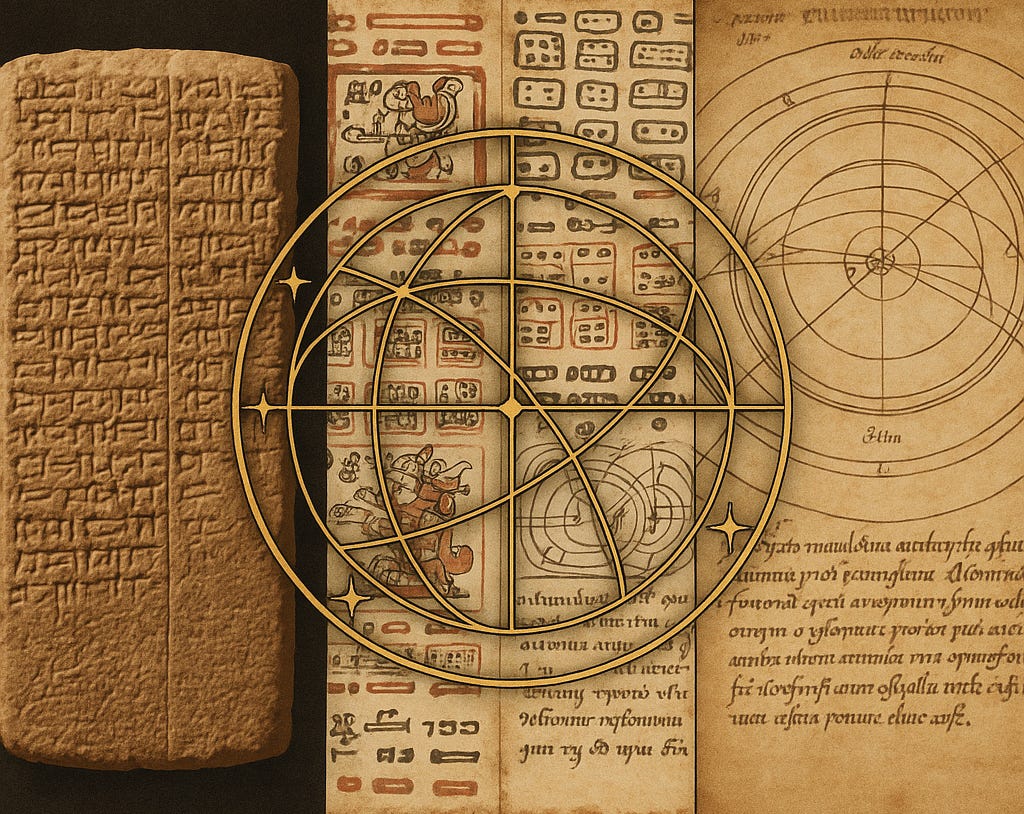
Before the word state existed, continuity belonged to those who kept the rhythm of the heavens.
Astronomer-priests of Babylon, the Maya calendar keepers, Egyptian temple mathematicians, medieval monastic scribes- each held fragments of a universal duty: to track time beyond a single lifetime.
They watched solststices trace their slow arcs.
They saw precession unfold across centuries.
They aligned stone with the sky.
Their role was not spiritual ceremony. It was the earliest form of continuity governance.
Hipparchus (129 BCE) discovered axial precession and extended human understanding to a 26,000-year cycle.
Bede synchronized Christian timekeeping across Europe.
In every case, knowledge of time was knowledge of stability.
Continuity began as observation- the recognition that patterns older than any kingdom must be carried forward if civilization is to last.
II. The Stone Ledger
Deep Time Discovered
With the Enlightenment, continuity moved from temple walls into the Earth itself.
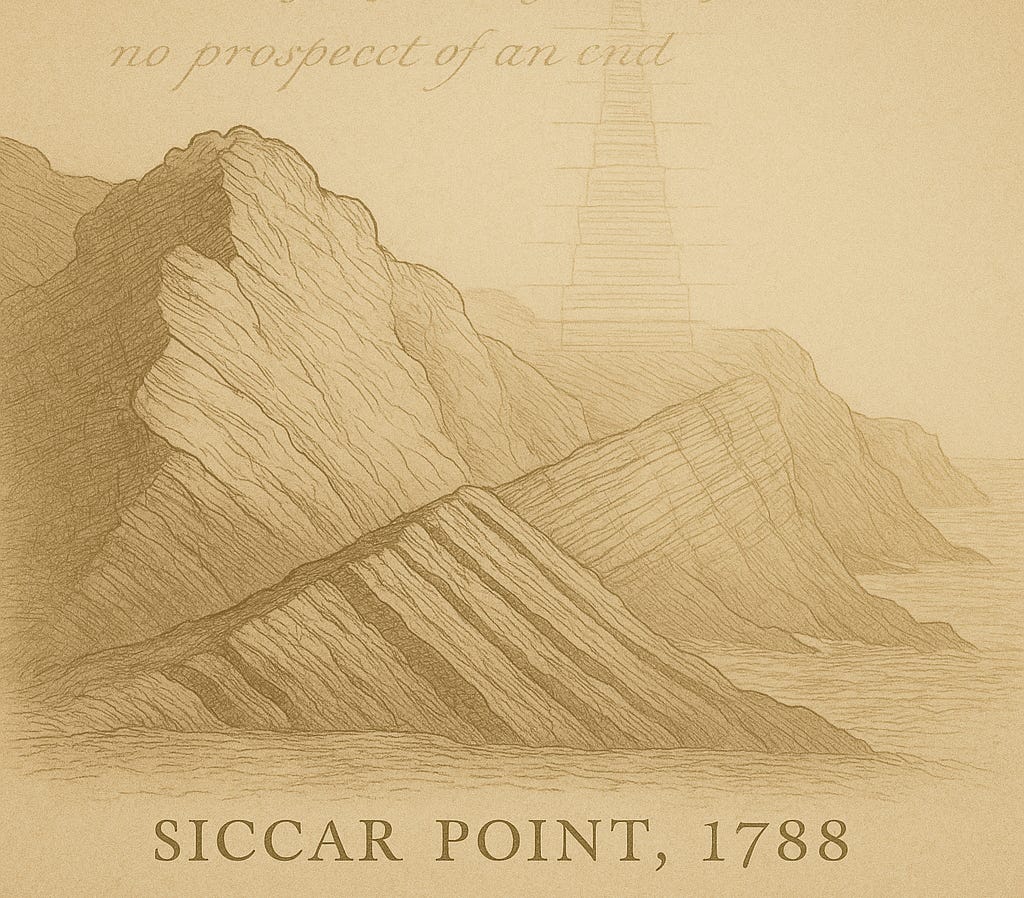
In 1788, James Hutton introduced deep time- arguing from strata, erosion, and uplift that Earth’s story spans millions of years.
Charles Lyell transformed this insight into a systematic principle: the slow, continuous forces shaping the present also shaped the past.
Humanity’s time horizon expanded exponentially.
The Earth became a ledger of continuity, its layers recording natural order across eras.
Suddenly, the ambitions of nations- railways, cities, irrigation systems, fleets- could be understood not as monuments against time, but participants in a much older temporal field.
Continuity gained physical grounding.
III. The Engineered Horizon
Precision as Responsibility
By the 19th century, continuity became a matter of precision.
The Age of Instruments arrived:
Harrison’s chronometers stabilized navigation
Gauss’s magnetometer unified geomagnetic measurement
John Milne’s seismograph (1880) enabled the first recordings of deep Earth movement
The global telegraph network synchronized continents
When Krakatoa erupted in 1883, its pressure wave circled the Earth multiple times, detected by barometers thousands of kilometers apart- the first planetary-scale physical signal ever recorded.
Infrastructure grew complex. Stability demanded literacy in:
load paths
groundwater tables
seismic margins
material fatigue
Continuity now required engineering.
Humanity was learning to listen to the Earth.
IV. The Subterranean Gaze
Mapping the Unseen
Industrial expansion demanded deeper visibility.
The early 20th century birthed subsurface sensing:
Seismic reflection (Fessenden, Karcher)
Gravity anomaly mapping
Magnetic surveys
Geodetic triangulation
Great geophysicists extended the subterranean map:
Andrija Mohorovičić discovered the crust–mantle boundary (the Moho).
Inge Lehmann revealed Earth’s solid inner core.
Harold Jeffreys established fundamental principles of planetary elasticity and wave propagation.
Later, Marie Tharp mapped the mid-ocean ridge, unlocking plate tectonics- humanity’s first coherent theory of planetary motion.
Yet vision remained fragmented.
Each domain produced a slice of truth.
No unified field existed.
Continuity still lacked coherence.
V. The System and the Satellite
Planetary Awareness
Mid-century systems science pulled the horizon wider.
Norbert Wiener introduced cybernetics- feedback, stability, control.
John von Neumann created the architecture for planetary simulation.
NASA and DARPA built the global sensing mesh.
Satellites measured continental drift, hydrology, gravity variation, and planetary energy balance.
Climate science matured.
Plate motion became measurable.
Global communications synchronized governance.
But the substrate, the deep structural engine beneath continents, was still only indirectly inferred.
Continuity had become planetary, but its foundation remained opaque.
VI. The Coherent Field
The Substrate Becomes Legible
The 21st century produced the decisive shift: the substrate became legible.
Advances in:
continuous gravity observation
interferometric seismic coherence
GPS + InSAR deformation monitoring
high-performance inversion algorithms
yielded the first unified causal description of Earth’s interior:
the gravitational flow field; a single, continuous 4D architecture through which mass, stress, and energy migrate.
This field is not a metaphor.
It is the first-principles driver of:
mantle convection
slab pull
crustal locking
seismicity
subsidence
infrastructure deformation
Seismic waves, gravity anomalies, and surface motions are projections of this one causal system.
For the first time, the Earth speaks in a continuous language.
VII. The Translation Layer- The Causality Lens™
From Physics to Governance
The Geostructural Commons provides the ledger, the continuously resolved physical state of the Earth.
But a ledger alone does not govern.
The Causality Lens™ is the interpretive engine that converts:
gravitational flow
stress coherence
boundary integrity
energy accumulation
into sovereign-grade causation suitable for governance, underwriting, and long-horizon capital.
It performs three indispensable functions:
Coherence Resolution
Distinguishes stable stress flow from dangerous lock-up.Threshold Proximity
Measures how close a system is to irreversible structural reorganization.Directional Causality
Determines how and where failure would propagate if triggered.
Every continuity instrument, covenant, or structural guarantee is written through this Lens.
VIII. The Metric- CIM: The Pulse of the Field
The Causal Integrity Metric (CIM) is the scalar compression of how the gravitational field is deforming a system’s engineered interfaces.
It is not a probability.
It is not a loss curve.
It is not hazard forecasting.
CIM quantifies:
causal departure from baseline
irreversibility of deformation
criticality of the affected nodes
as a pre-failure physical health score of systems, corridors, and nations.
High CIM = coherent field, stable dissipation.
Low CIM = discontinuity, energy accumulation, imminent topology change.
This is the first metric that allows sovereigns to govern continuity before loss occurs.
IX. Prototype Specification- The EurAfrica Seismic Shield
Template for Causal Governance
(Formal, not deployed)
The EurAfrica Seismic Shield is the first full-scale continuity architecture engineered for sovereign evaluation.
It is not deployed.
It is not funded.
It is a prototype specification, demonstrating how a causality-indexed instrument would operate once adopted.
Purpose
Convert the Mediterranean–North African seismic exposure, historically unmanaged, into a governed, causal-denominated asset class.
Prototype Architecture
Exposure reference: ~$1.24T sovereign + infrastructure vulnerability
Shield size (specification): $23B parametric continuity pool
Trigger mechanism: CIM thresholds derived from the Causality Lens™
Function: Pre-catastrophe liquidity for sovereigns once physical thresholds approach irreversibility
Settlement layer: Geostructural Commons
Role in the Doctrine
The Shield is a template, not a precedent.
It shows sovereigns what a causal covenant looks like:
written in the grammar of physics
settled on a neutral ledger
triggered by first-principles causation
designed to prevent irreversible loss
It is the bridge between the deep field and sovereign balance-sheet design.
X. Sovereignty Written in Stone
Governance Becomes Structural
A nation that perceives the substrate acquires a deeper sovereignty.
It sees:
the slow drift of coasts
the locking of seismic corridors
the quiet accumulation of strain under cities
the long-memory behaviour of basins and shelves
With CIM and the Causality Lens, governance becomes structurally informed.
Continuity becomes an operational domain- not a hope, but a system.
XI. The Constructed Future
Engineering Stability
A stable future must be engineered.
It requires:
perception (the Commons)
translation (the Lens)
measurement (CIM)
instruments (Continuity Capital)
Subterrane operates this denominator- the architecture that allows nations to govern the deep field rather than be governed by it.
Through structure, the future gains form.
Through form, it becomes navigable.
Through navigation, it becomes continuous.
XII. The New Horizon
Civilizational Memory
Civilizations are remembered by how far they extended their horizon beyond themselves.
This century’s horizon is structural continuity- the stewardship of planetary architecture itself.
The planet is now legible.
Continuity is now governable.
The future, finally, can be steadied.
Subterrane exists to serve as the instrument of this alignment:
the lens through which nations inherit the long horizon with clarity, competence, and care.
Dispatch 032- Continuity, Part 2
On the Sovereign Construction of the Future
The Deep Frontier Series
Bridge: From Inheritance to Custody
If the first task of continuity was to inherit time- to observe it, measure it, and slowly render it intelligible- the second task is more demanding. What has been seen must now be carried forward deliberately. The passage from deep time to the future is not automatic; it requires custody. The same forces that once revealed themselves through strata, instruments, and fields are no longer content to remain descriptive. They are beginning to assert themselves operationally, pressing against institutions, balance sheets, and built environments. This is the moment where knowledge ceases to be historical and becomes architectural. Continuity, having been understood, now asks to be governed.
I. Continuity Beyond the Horizon
Dispatch 032 (Part I) established continuity as the longest responsibility civilization carries- a duty extending beyond leaders, institutions, and eras.
What has changed is not the responsibility, but the margin for error.
For centuries, discontinuities could be absorbed by surplus: geographic expansion, demographic growth, energetic abundance, fiscal elasticity. That surplus has collapsed. Climate volatility, infrastructure aging, energy constraint, and sovereign balance-sheet saturation have compressed the temporal buffer that once shielded governance from structural misalignment.
Continuity is no longer a distant virtue exercised at leisure. It is an operational requirement under time pressure.
The horizon has not moved farther away. It has moved closer.
Over the past decade, this compression has ceased to be theoretical. Insurance withdrawal from seismic, flood, and subsidence corridors; reinsurance repricing beyond sovereign tolerance; infrastructure renewal backlogs exceeding fiscal capacity; and capital retreat from exposed regions are no longer early warnings — they are measurable signals. What unites them is not policy failure or market sentiment, but a shared blind spot: exposure accumulated without causal visibility. Across energy, transport, housing, defense, and digital infrastructure, systems built on probabilistic abstraction are now encountering deterministic constraint. The result is not crisis, but reversion- the steady reassertion of structure where approximation once sufficed.
II. The Return of Structure
The late 20th century fostered a belief that the substrate no longer mattered- that cities could float above geology, that capital could price risk without reference to ground, and that digital systems could detach from energy, water, and terrain.
This belief expressed itself materially:
Cities expanded into subsiding basins and floodplains
Infrastructure aged beyond design margins without causal monitoring
Energy systems optimized for efficiency rather than continuity
Finance priced exposure probabilistically without physical reference
Logistics networks optimized for speed, not shock tolerance
These were not ideological errors.
They were engineering blind spots.
What appears today as instability is not disorder.
It is the reassertion of structure under load.
The ground never stopped moving.
Strain accumulated.
Locked zones tightened.
Basins compacted.
Continuity was not threatened.
It was ignored- until it became unavoidable.
III. The Grand Inversion
Modernity mistook convenience for freedom.
Probability substituted for understanding. Correlation replaced causation. Software was treated as a proxy for physics. Risk was modeled statistically rather than governed structurally.
This worked only while variance remained bounded.
As compound disasters, cascading failures, and systemic stress widened the tails, probabilistic systems lost coherence. Insurance withdrew. Reinsurance repriced. Capital retreated. Sovereign balance sheets absorbed the difference.
The inversion now underway is not philosophical.
It is financial.
Capital is abandoning noise because noise no longer clears.
The world is returning; not by choice, but by necessity to the only foundation that ever held: causality.
IV. Exposure Without Understanding
What is often described as decentralization is, in reality, dispersion into deterministic exposure.
Distributed grids, exurban development, mobile logistics, data centers, defense infrastructure, and energy corridors are being placed directly atop gravitational flow lines that have governed landscapes for millions of years.
Exposure now extends beyond housing and cities into strategic systems:
Energy corridors strained beyond thermal and mechanical design limits
Logistics networks vulnerable to surface deformation and nodal failure
Defense supply chains incapable of surge under structural constraint
Data centers dependent on groundwater, heat dissipation, and grid coherence
Distributed systems without causal grounding do not reduce risk.
They multiply it.
Exposure is not temporary.
It is structural.
Once recognized, it becomes governable.
Once ignored, it becomes cost.
V. Resilience Debt and the Collapse of Noise
Resilience Debt is not a metaphor.
It is the accumulated burden of building on approximation instead of truth.
Its signatures are now measurable:
Entire regions rendered uninsurable
Infrastructure repair backlogs measured in decades
Sovereign debt absorbing physical loss
Defense inventories depleted faster than replenishment
Utilities failing outside historical parameters
These are not failures of management.
They are accounting errors rooted in causal blindness.
The collapse of noise is not sudden.
It is cumulative.
Civilization is now paying interest on Resilience Debt- and discovering that probabilistic instruments cannot service it.
Continuity can only be governed through causality.
VI. Subterrane and the Causal Truths of the Earth
Subterrane does not offer better maps.
It replaces mapping altogether.
The Earth is resolved as a continuous gravitational flow field- the first-principles architecture through which mass, stress, and energy migrate across time and scale.
This field governs:
Mantle convection and slab pull
Crustal locking and seismic release
Subsidence, uplift, and basin behavior
Infrastructure deformation and corridor fatigue
Seismic waves, gravity anomalies, and surface motion are not independent phenomena.
They are projections of a single causal system.
Subterrane emerges not as an alternative framework, but as a replacement architecture- required when probabilistic systems can no longer clear risk under load.
VII. The Causality Premium and the Nine Instruments
The world’s next premium is not technological, demographic, or political.
It is the Causality Premium.
This premium emerges when assets, corridors, and sovereign obligations are indexed directly to deterministic substrate behavior rather than statistical surface noise.
The nine Subterrane Instruments form the first uncorrelated asset class remaining in the global system:
Sovereignty Covenant
Stability Tranches
Terrain Derivatives
Causality Bonds
Resilience Warrants
Gravity Notes
Builder’s Certification
Data Consignment
Cartography License
As sovereigns reallocate capital toward infrastructure renewal, adaptation, and continuity, these instruments become the only class capable of absorbing scale without amplifying volatility.
They are not synthetic.
They are structural.
They allow nations to restructure Resilience Debt before loss becomes irreversible.
VIII. AI and the Physical Layer
Artificial Intelligence transforms systems only when grounded in causality.
Models trained on correlation hallucinate.
Models trained on noise misprice.
Models trained on causal structure become deterministic.
Recent operational and financial failures have demonstrated this clearly: correlation-trained systems break precisely when stress becomes systemic.
Causality is not an enhancement to AI.
It is the condition of its reliability.
Subterrane provides the missing physical grounding layer for planetary computation; aligning intelligence with the deep physics of the Earth.
AI without causality approximates the world.
AI with causality inhabits it.
IX. The Sovereign Horizon
The future will not belong to the fastest software, the largest model, or the most distributed network.
These advantages persist only in worlds where the substrate is ignored.
The only sustainable advantage is alignment with causality.
Nations that adopt causal infrastructure, causal finance, and causal governance will anticipate deformation, align utilities with gradients, site settlements within coherent domains, and direct capital along structural lines.
Nations that remain probabilistic will subsidize their own repair.
This is not ideology.
It is selection pressure.
X. The Moment of Clarity
Civilization is not entering an age of uncertainty.
It is entering the age where uncertainty dissolves into causality.
The transition is no longer generational.
It is unfolding within this decade.
Continuity has moved from memory to protocol.
From philosophy to engineering.
From hope to governance.
The ground is moving.
It always was.
For the first time, we can see its motion, price its consequences, and build within its logic.
This is the sovereign responsibility of the future.
This is the architecture of Continuity.
This is Subterrane.
References & Sources
(Integrated for Dispatch 032)
Primary Doctrine
Long, A. J. (2025). The Gravitational Causality Framework for Planetary-Scale Infrastructure Integrity and Force-Indexed Capital. Subterrane White Paper.
Long, A. J. (2025). The First Financial Instruments Priced in the Language of Earth’s Gravity Field. LinkedIn Articles.
Historical Foundations
3. Hipparchus (129 BCE). Precession of the Equinoxes.
4. Bede, Venerable (731). De Temporum Ratione.
5. Hutton, J. (1788). Theory of the Earth.
6. Lyell, C. (1830). Principles of Geology.
Instrumentation & Geophysics
7. Harrison, J. (1760s). Marine Chronometer.
8. Gauss, C. F. (1833). Magnetometer Work.
9. Milne, J. (1880). First Modern Seismograph.
10. Mohorovičić, A. (1910). Discovery of the Moho.
11. Lehmann, I. (1936). Discovery of the Inner Core.
12. Jeffreys, H. (1924–1958). Elasticity & Wave Propagation.
13. Tharp, M. (1957). Mid-Ocean Ridge Mapping.
14. Fessenden, R. (1917). Reflection Seismology.
Systems Science & Planetary Measurement
15. Wiener, N. (1948). Cybernetics.
16. von Neumann, J. (1950s). Planetary Simulation Architecture.
17. Manabe, S. (1967). First CO₂–Climate Equilibrium Model.
18. NASA GEOS, GNSS, and LAGEOS Missions (1976–present).
Modern Geophysical Integration
19. GRACE & GRACE-FO Missions (2002–present).
20. InSAR Global Deformation Measurements.
21. Global Seismic Networks (IRIS, USGS, GEOSCOPE).
22. High-Performance Tomographic Inversion Literature (2010–2025).
Causal Finance & Governance
23. Long, A. J. (2018–2025). Subterrane Doctrinal Briefs.
24. Catastrophe Finance Literature (Swiss Re, Lloyd’s, GFDRR).
25. Sovereign Risk & Stability Governance (IMF, BIS, World Bank).
Civilizational Continuity
26. Japanese Tsunami Stones (14th–20th c.).
27. Dutch Delta Works (20th–21st c.).