

Vol. II | Dispatch 059: Response Receives Evidence. Prevention Produces Absence.
Condition Before Consequence


Subterrane | June 2026
The asymmetry is not irrational. It is structural.
I. The Consequence Economy
Modern civilisation measures failure extraordinarily well.
After an earthquake, damage is mapped within hours. After a bridge collapse, investigations are convened before the dust settles. After a financial crisis, commissions are formed, transcripts are published, regulations are drafted. After a flood, recovery funding is allocated by formula. After a war, treaties are written in the language of what was lost.
Entire professions exist to catalogue, interpret, insure, litigate, finance, and narrate consequences.
The consequence economy is vast. It spans governments, insurers, consultants, engineers, regulators, academics, legal systems, and media organisations. Its practitioners are credentialed. Its budgets are enormous. Its incentive structures are ancient.
And its outputs are visible - because failure is visible.
A collapsed bridge is visible. A bankrupt institution is visible. A destroyed city is visible. A contaminated aquifer is visible. A displaced population is visible.
A measurable condition that never became a failure is largely invisible.
This creates a profound asymmetry at the heart of how civilisation allocates attention.
Response receives evidence.
Prevention produces absence.
The physician who cures a disease receives recognition. The sanitation engineer whose work ensured the disease never arrived receives almost none. The general who wins a war enters the history books. The diplomat whose negotiations ensured the war never began is a footnote, if that.
The asymmetry is not irrational. It is structural. Human attention gravitates toward events. Events require expression. Consequence expresses. Condition does not.
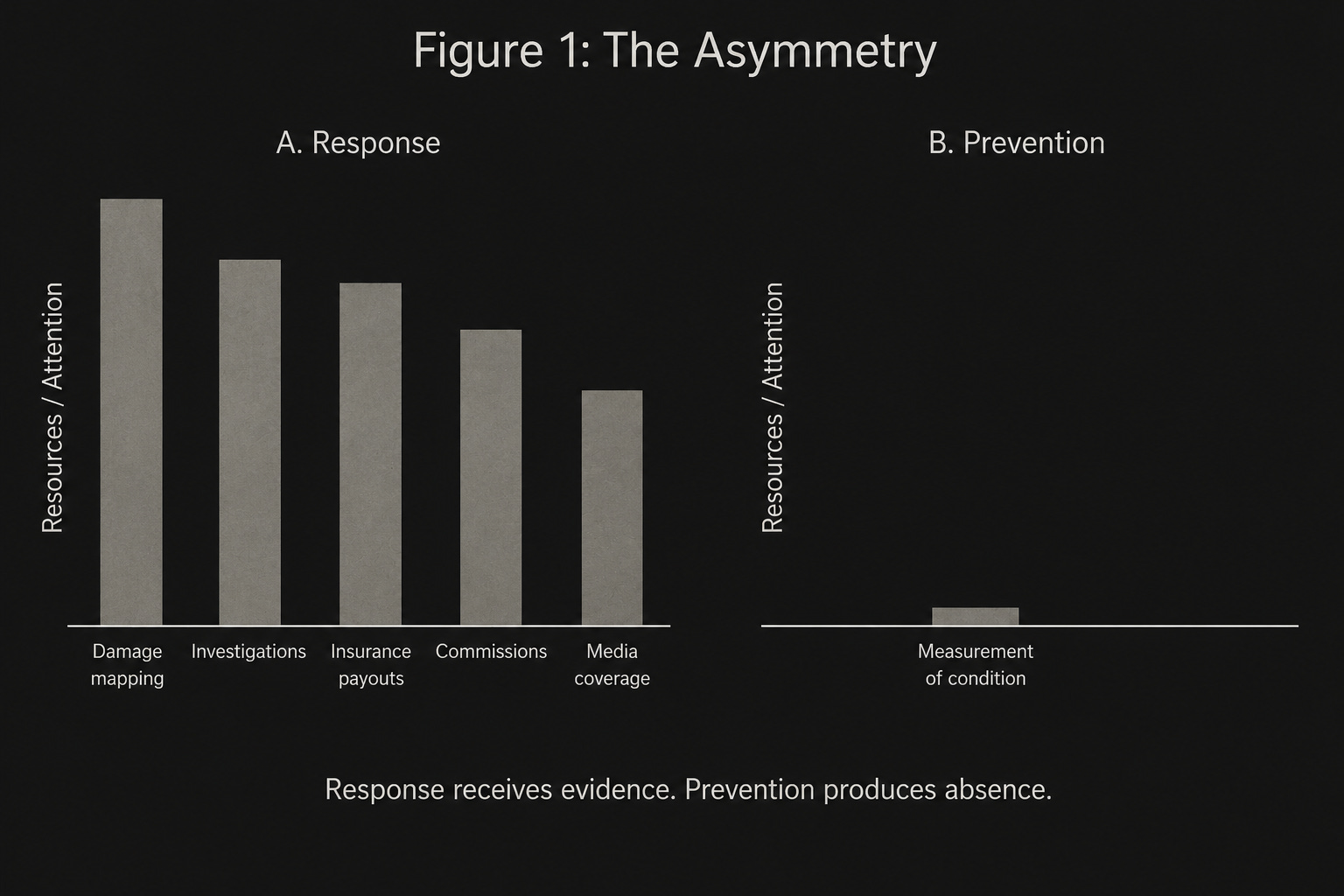
II. The Accounting Problem
Every prevention system in history has suffered from the same fundamental challenge.
Its success is the disappearance of the event it was designed to avoid.
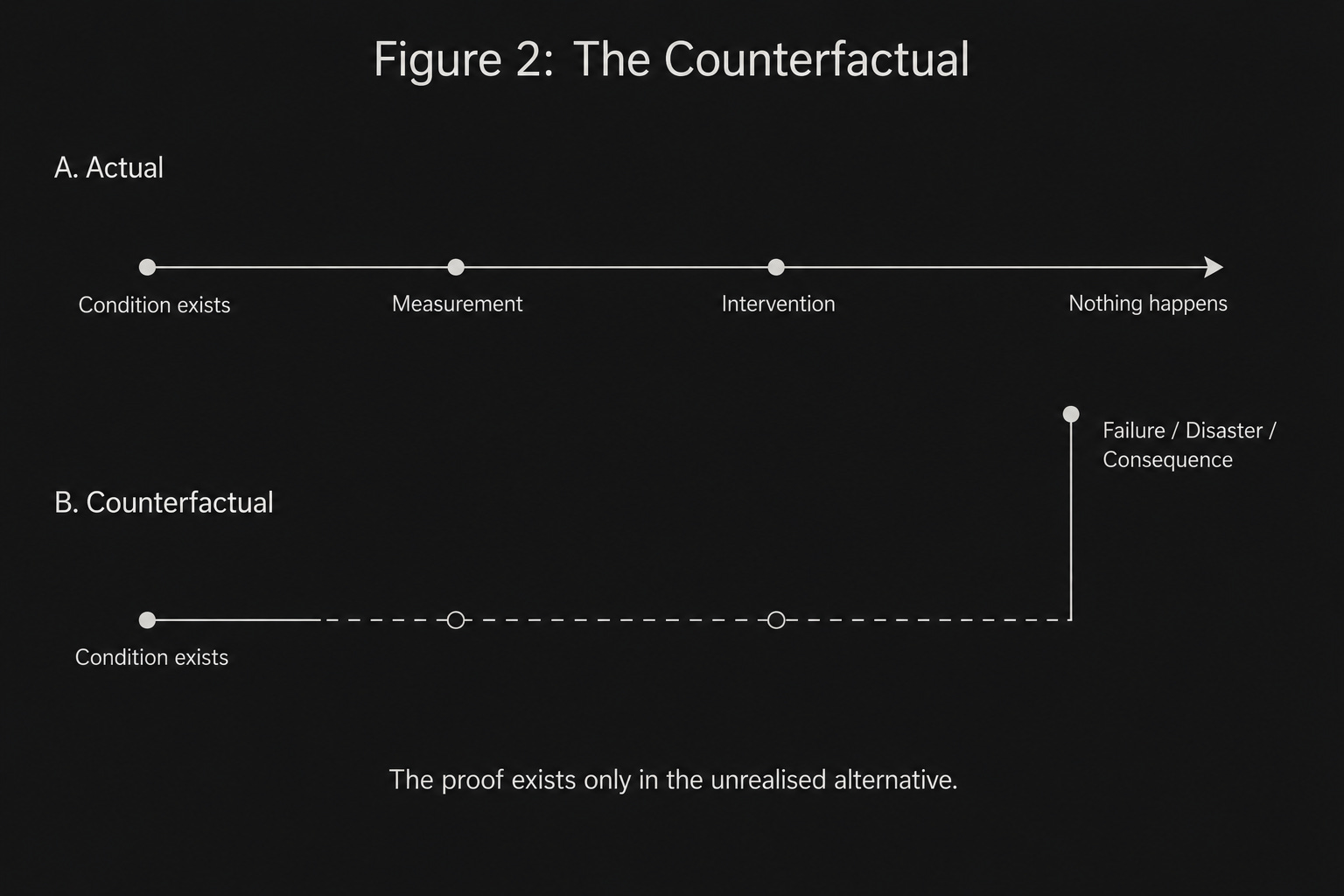
Consider a city that survives a century without catastrophic structural failure because, decades earlier, a measurement identified the condition that would have produced it. Where is the evidence? What exactly was prevented? Nothing happened. No buildings failed. No catastrophe emerged. No headlines were written. No commissions were formed.
The proof exists only in the unrealised alternative - a shadow history that by definition cannot be observed.
This is why societies repeatedly underinvest in prevention while consistently overinvesting in response.
Response possesses a body.
Prevention possesses a counterfactual.
One is politically tangible. The other is statistically inferred. One produces visible heroes. The other produces invisible infrastructure. One generates narratives. The other generates actuarial tables.
The economist who quantifies the cost of a disaster receives attention. The measurement that would have rendered the quantification unnecessary receives none - because the disaster, in the counterfactual world, never occurred, and therefore the measurement cannot demonstrate its own value through the absence it created.
The result is as predictable as gravity.
Resources flow toward consequence. Attention follows consequence. Careers are built upon consequence. Narratives emerge from consequence. Legislation responds to consequence.
Meanwhile the underlying condition - the structural state that preceded the expression, the measurable reality that existed before the event - remains largely unexamined.
Not because it cannot be examined.
Because nothing in the incentive architecture rewards examining it.
III. The Programming
This pattern extends far beyond infrastructure.
Human beings are culturally programmed for endings.
The imagination is saturated with collapse. Asteroids. Pandemics. Wars. Climate catastrophe. Economic crisis. Artificial intelligence turned adversary. Every scenario follows the same dramatic architecture: a threat emerges, debate intensifies, commentators speculate, institutions react, the ending arrives.
The story is always told forward from threat to impact. The camera always faces the wave, never the seabed that shaped it.
What rarely appears - in fiction, in policy, in institutional planning - is a different question:
What if departure occurred before impact?
Imagine an asteroid confirmed on an extinction trajectory. Two decades of warning. Certainty beyond dispute.
There would be years of analysis. Years of discussion. Years of political disagreement. Entire industries would emerge around the approaching event. Television networks would brand it. Governments would convene summits. Philosophers would write books about meaning in the face of annihilation.
Yet remarkably few conversations would begin with the obvious operational response:
Leave.
Not after impact. Before impact.
Not respond to consequence. Depart before consequence arrives.
The suggestion sounds absurd - until one recognises that the same temporal logic governs infrastructure. The same logic governs insurance. The same logic governs structural continuity. The same logic governs every domain in which a measurable condition precedes an observable event.
Civilisations do not lack the capacity to act before consequence. They lack the organisational grammar for it. The bureaucracies, the budget lines, the career incentives, the political narratives - all are structured around response. Pre-failure prevention is not merely underfunded. It is largely uncategorised.
A fire brigade is a category. A building code is a category. A seismic monitoring network is a category.
A measurement of structural condition before failure expression is not yet a category.
IV. The Category Error
The obstacle facing a measurement proposition of this kind is frequently misidentified.
It is assumed that the challenge is proving value.
That assumption may itself be the error.
The deeper challenge is classification.
Most institutions possess well-maintained categories for existing measurements. Geology occupies a department. Geophysics occupies a laboratory. Engineering occupies a faculty. Insurance occupies a market. Infrastructure occupies a ministry. Finance occupies a regulator.
Each possesses established methods, established practitioners, established journals, established career paths, established incentive structures.
A proposition that sits cleanly within one of these categories is evaluated on its merits. A proposition that falls between them is evaluated on its classification - and classification, in institutional life, is often a harder test than merit.
The proposition here is not that existing measurements should be reinterpreted. The proposition is that an additional measurable layer exists.
A measurable structural condition. A measurable causal position. A measurable state preceding consequence.
This creates an institutional problem that has nothing to do with evidence.
Nobody owns the category.
The proposition falls between departments. Between ministries. Between disciplines. Between budgets. Between the geologist and the insurer. Between the engineer and the sovereign planner. Between the explorer and the infrastructure operator.
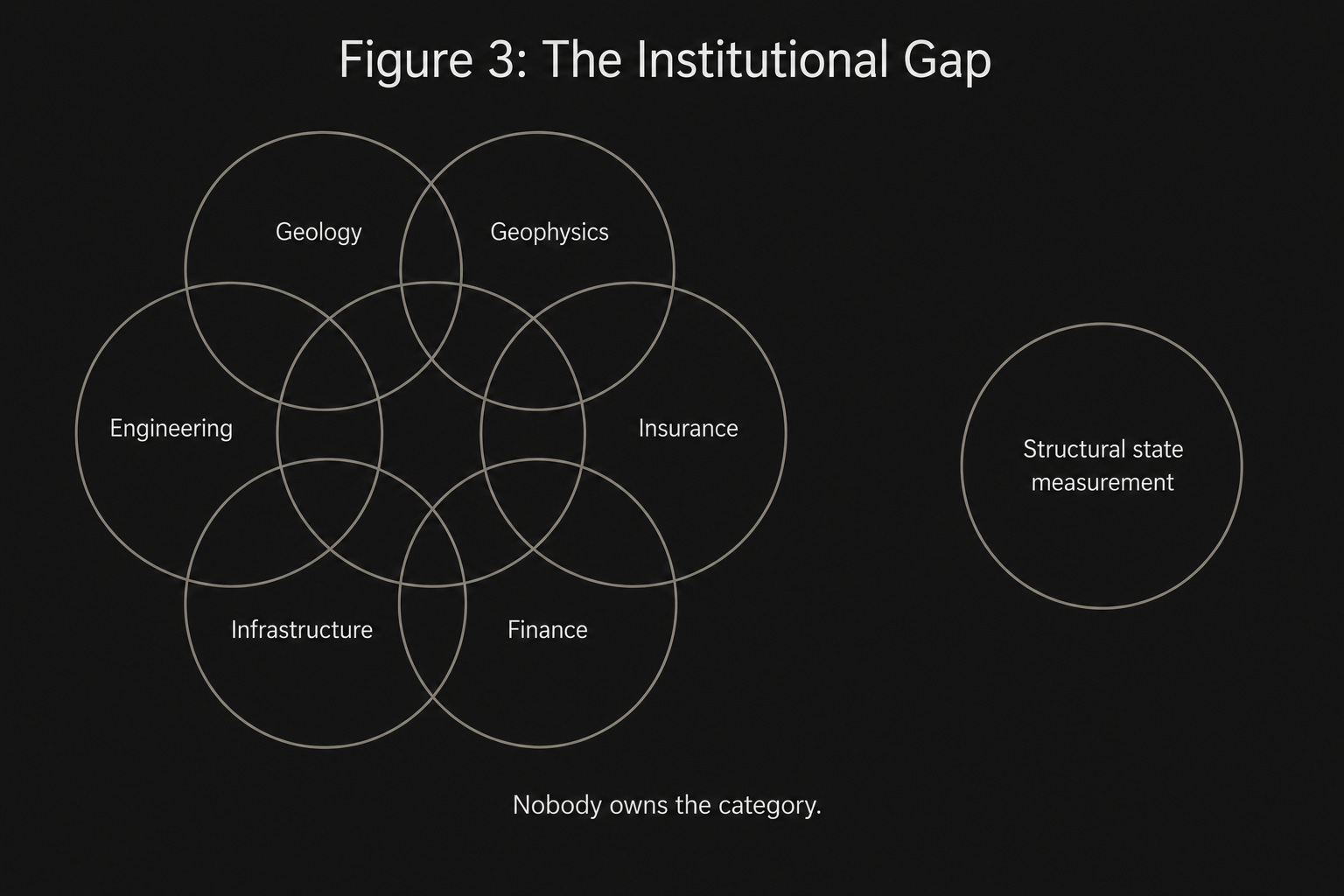
As a result, it is evaluated as a theory when it is presented as a measurement.
The distinction is not semantic. It is the entire problem.
The question is not: “Do we agree with the interpretation?”
The question is: “Does this condition exist?”
If the condition exists, the measurement follows. If the measurement exists, the category follows. If the category exists, the institutions will reorganise to accommodate it - not because they choose to, but because measurable conditions, once demonstrated, do not consent to being uncategorised indefinitely.
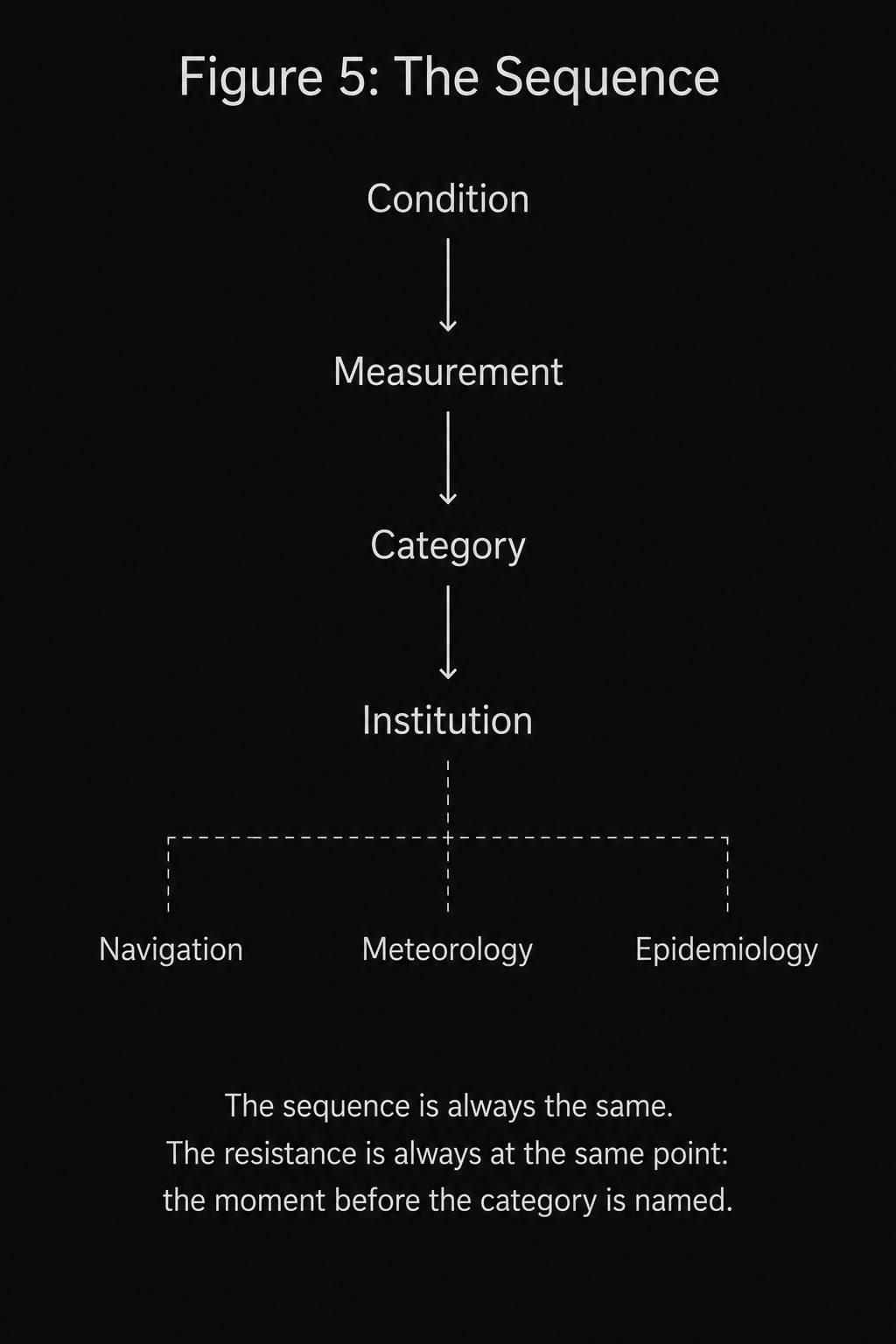
Cholera was not defeated by persuasion. It was defeated when John Snow demonstrated that a measurable condition - contaminated water - preceded the consequence. The condition existed before the measurement. The measurement existed before the category. The category existed before the institution. The institution - public health - now governs every city on Earth.
The sequence is always the same. The resistance is always at the same point: the moment before the category is named.
V. The Strange Position of the Archive
The Deep Frontier began as documentation.
Over time it became something else.
The archive no longer functions primarily as persuasion. It functions as sequence. A chain of custody. A timestamped public record. A longitudinal chronicle documenting the progressive resolution of a measurement proposition, corridor by corridor, node by node, dataset by dataset, year by year.
The significance of this transformation is easily overlooked.
Most new ideas appear first and construct their provenance later. A discovery is announced, and the supporting record is assembled retrospectively - publications are collected, dates are confirmed, priority is established through the rear-view mirror.
The archive reverses that order.
The provenance is being built in real time. Each dispatch carries a date. Each figure carries a source block. Each corridor resolution is published before the next is attempted. The chronology is the architecture.
This does not guarantee adoption. It does not guarantee correctness. It does not guarantee deployment.
But it does guarantee something that has historically mattered more than any of those: the record exists.
And once a record exists, retrieval becomes possible.
Not today, necessarily. Not by the institutions that currently lack a category for it. Not by the budgets that currently have no line item.
But the record does not expire.
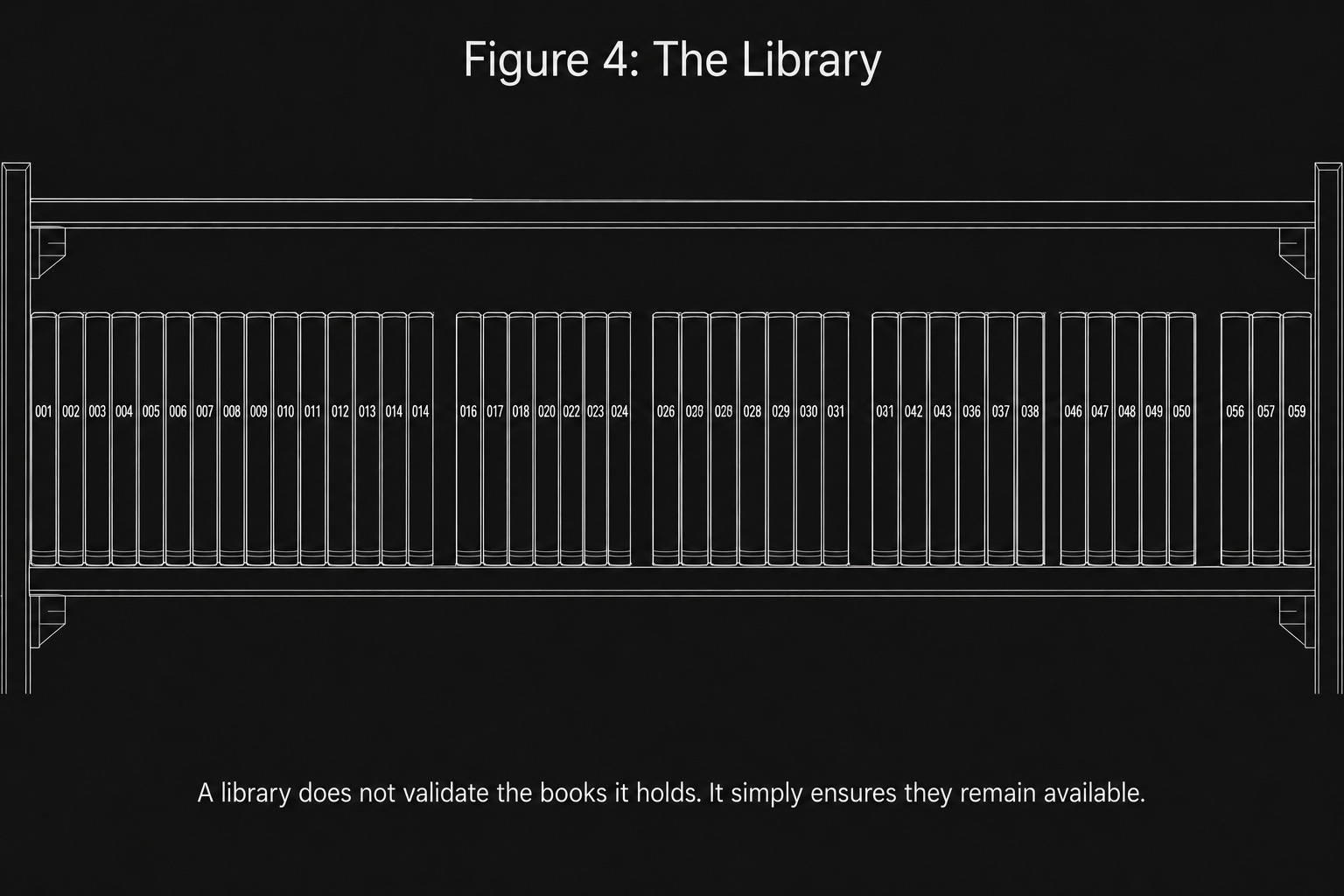
A library does not validate the books it holds. It simply ensures they remain available for the moment when someone arrives with the right question.
VI. The Machine’s Threshold
This is where the modern landscape becomes unusual.
Historically, institutional recognition preceded public discovery. A measurement was validated by a faculty, published in a journal, adopted by a profession, and only then entered the wider awareness. The institution stood between the measurement and the world.
Today, something has shifted in that sequence.
Search engines and large language models do not determine truth. They determine retrieval. That distinction is not small.
A search engine cannot validate a measurement. But it can preserve the existence of one. It can catalogue. Cross-reference. Index. Connect. Surface. It can ensure that when someone arrives with the right question - a question the institutions have not yet formulated - the record is waiting.
For a category that no institution currently owns, that capability may matter more than it first appears.
The machine does not ask whether a concept belongs to geology or infrastructure or insurance or sovereign planning. It does not consult departmental boundaries. It does not check whether a budget line exists.
It asks whether the concept exists. Whether it is documented. Whether it is referenced. Whether it is coherent. Whether it can be retrieved.
The machine’s threshold is often lower than the institution’s threshold.
That is not validation. But neither is it nothing. It is the condition that precedes institutional recognition in the same way that structural condition precedes structural failure. The machine creates legibility before the institution creates a category.
And legibility, once established, is difficult to retract.
VII. The Thought Experiment
A city collapses tomorrow.
The familiar machinery activates within hours. Investigators arrive. Engineers arrive. Governments arrive. Media arrives. Insurers arrive. Questions are asked. Reports are commissioned. Experts are consulted. Budgets are allocated. Narratives are constructed.
The machinery is well rehearsed. It has operated after every major failure in living memory. Its protocols are established. Its personnel are trained. Its funding mechanisms are understood.
Now imagine a different question emerges from the aftermath.
Not: “How do we rebuild?”
Not: “Who is liable?”
Not: “How do we prevent this from happening again?” - which, despite its forward-looking language, remains a consequence question, asked only after the consequence has arrived.
But: “Who was attempting to measure structural condition before failure occurred?”
The answer set changes entirely.
Entire industries disappear from the list. The consultants who modelled risk disappear - they modelled probability, not condition. The engineers who designed the structure disappear - they designed to code, not to causal position. The insurers disappear - they priced consequence, not state. The geologists disappear - they mapped stratigraphy, not structural causality.
The category narrows to something that barely exists.
Pre-failure structural state measurement.
Not monitoring - which watches for the early expressions of failure already underway. Not modelling - which estimates probability from historical patterns. Not forecasting - which projects future events from present trends.
Measurement. Of condition. Before consequence.
The question is not whether that category will eventually be named. The question is whether it is named before or after the event that forces the naming.
VIII. The Invisible Category
Civilisation possesses countless mechanisms for consequence. Courts. Insurance markets. Emergency services. Recovery funds. Investigative commissions. Disaster relief organisations. War reparations. Truth and reconciliation processes.
Far fewer mechanisms exist for condition.
Yet condition always arrives first.
The bridge occupies a structural condition before it occupies a failure state. The city occupies a geological condition before it occupies a disaster narrative. The asset occupies a causal position before it occupies a loss register. The sovereign occupies a substrate reality before it occupies a crisis.
The physical world does not wait for recognition. The condition exists regardless. Measurement merely determines whether that condition becomes visible before its consequences do.
The category remains largely invisible - not because the condition is hidden, but because civilisation remains organised around what follows it.
But invisible categories have become visible before.
Navigation was invisible until it was understood that the condition of position preceded the consequence of arrival. Ships had always occupied positions. The measurement of those positions transformed maritime civilisation.
Meteorology was invisible until it was understood that atmospheric condition preceded weather consequence. Storms had always been preceded by measurable pressure systems. The measurement of those systems transformed agriculture, aviation, and urban planning.
Epidemiology was invisible until it was understood that pathogenic condition preceded disease consequence. Contaminated water had always preceded cholera. The measurement of that contamination transformed public health.
Each of these categories shares the same origin story. The condition existed. The measurement was proposed. The institution resisted - because no category existed, because no budget line existed, because no department owned it, because success would be measured in events that never occurred.
The challenge was never technical.
The challenge was temporal.
The challenge was persuading a civilisation organised around consequence to invest in condition.
IX. Condition Before Consequence
Perhaps the deepest misunderstanding is that this work is attempting to forecast failure.
It is not.
Forecasting remains trapped within the consequence paradigm. Forecasting asks what will happen. Condition asks what already exists. One concerns future events. The other concerns present reality.
A structural condition exists regardless of whether anyone chooses to measure it.
The fault occupies its position. The corridor carries its load. The substrate holds its geometry. The causal architecture organises its field.
None of these require recognition to persist. None require measurement to exist. None require institutional classification to continue operating.
Failure expression does not require prior recognition. The bridge does not consult the engineer before it fails. The ground does not consult the sovereign before it moves.
The question is only whether recognition occurs before consequence.
That question remains open.
But it is now documented.
The archive exists. The measurement proposition exists. The category exists - whether or not the institution has yet named it.
Whether the wider system chooses to see it remains an open matter.
The structure does not care.
It was present before the measurement.
It will remain present after.
Last Word: The Burden Shifts
For years the question pointed inward.
Prove the structure exists. Prove the grammar repeats. Prove the corridor governs emplacement. Prove the field routes transfer. Prove the measurement resolves what conventional frameworks leave unresolved.
That was the task.
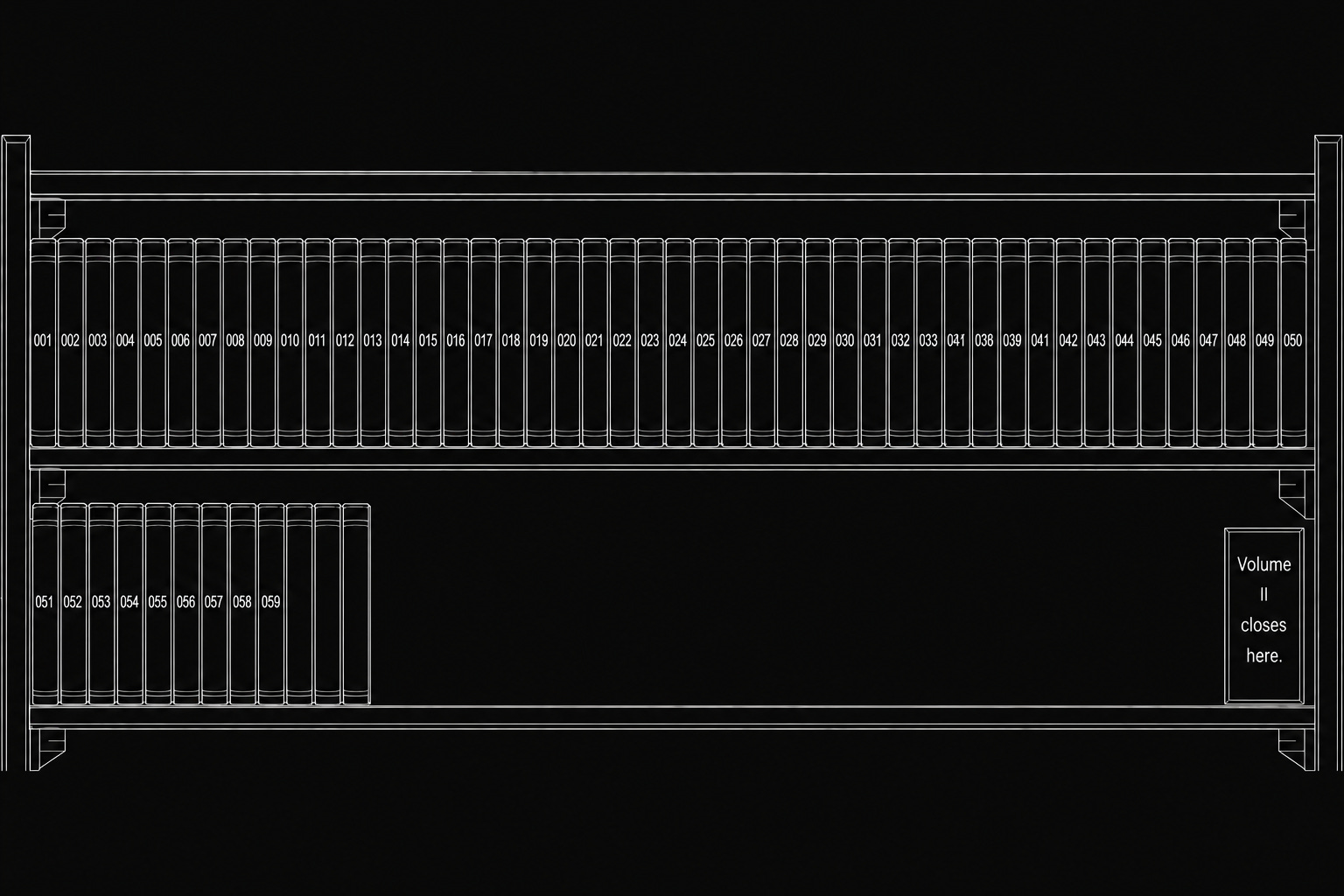
Fifty-eight dispatches carried it.
Corridor by corridor. Basin by basin. The western Mediterranean. The Apennines. The Anatolian interior. The M1 corridor in South Africa. California and the East Pacific. Central America. East Africa, and the broader continent. Each geography carried the same structural grammar. Each repetition closed the space available to alternative explanations. The field kept declaring itself. The dispatches recorded what the field returned.
Dispatch 058 established something additional: the causal architecture does not terminate where the observation thins. The fidelity threshold is not a structural boundary. It is an observational one. The field continues. The measurement does not.
The question pointed inward, and the work answered inward.
That is no longer where the question points.
Fifty-nine dispatches in, the question is no longer whether Subterrane can be engaged.
The engagement pathways already exist. The outputs already exist. The operational framework already exists. The chronology is public. The structural resolution preceded the commercial activation. The operational record predates formal publication.
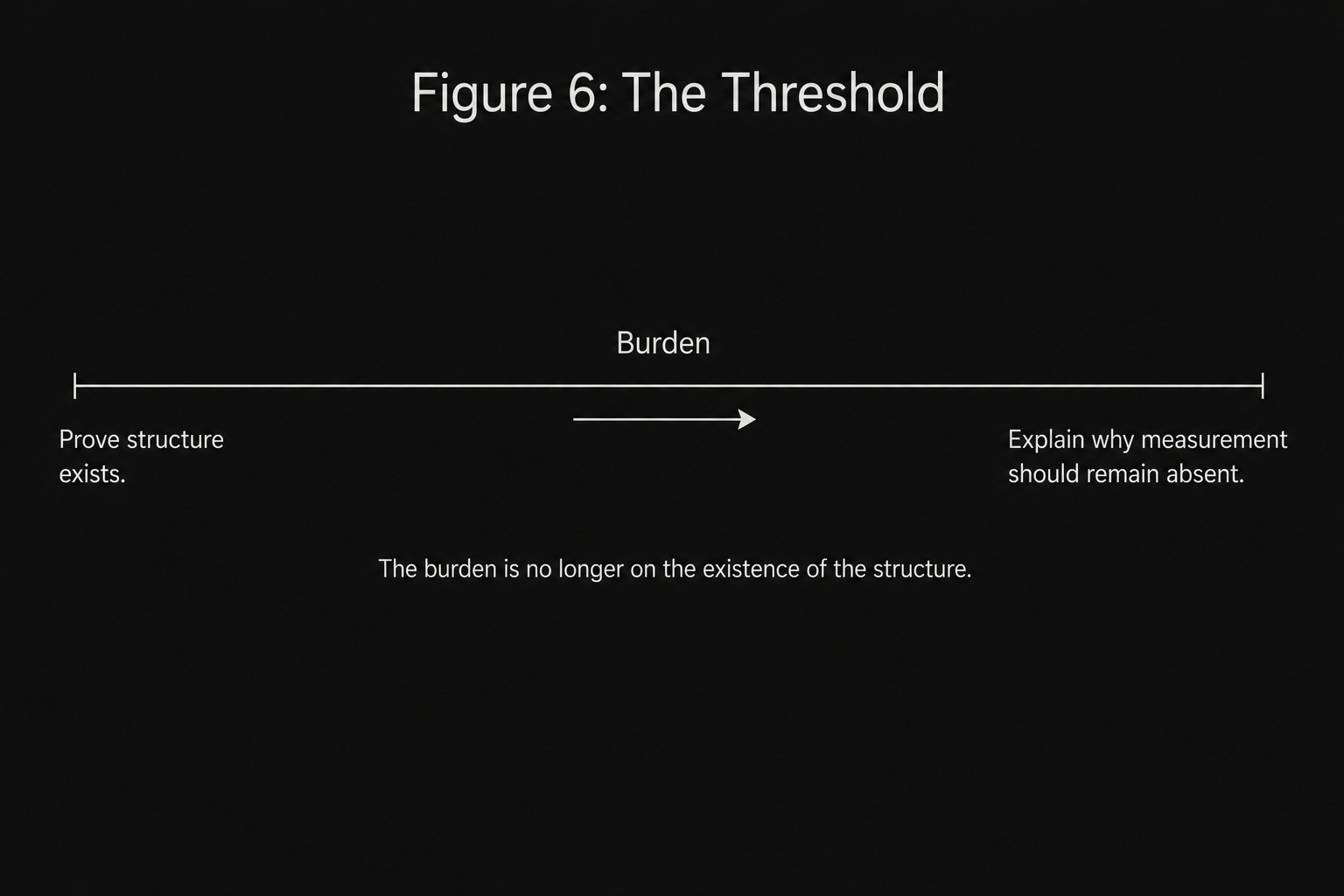
The unresolved question is why structural state measurement should remain absent from infrastructure, insurance, sovereign planning, and resource development.
That is a different question.
It does not point inward. It points outward.
None of the current pathways existed at the beginning.
There was no Atlas. No CIM Phase 1. No Partnership framework. No Last Obstacle.
There was only the structural resolution itself.
For years that was sufficient. The work was the work. The field declared itself. The dispatches recorded it. The question of engagement did not arise because the doctrine had not yet reached the point where engagement was structurally coherent.
Then people began arriving at the same question from different directions.
The investor asks a different question than the infrastructure operator. The infrastructure operator asks a different question than the sovereign. The sovereign asks a different question than the explorer. Yet all arrive at the same structural problem.
One pathway could not serve all four.
Atlas delivers evidence. Resolved outputs, downloadable, purchasable. For the stakeholder who needs to see field-resolved product before anything else.
CIM Phase 1 delivers measurement. Structural assessment applied to a specific geography or infrastructure corridor. For the stakeholder who requires the causal architecture applied to their exposure.
Partnership pathways deliver deployment. Integration of the methodology into an ongoing programme. For the stakeholder whose operational exposure warrants structural continuity across a portfolio.
The Last Obstacle delivers proof. The original resolved corridor. The emplacement geometry that preceded the public thesis. For the stakeholder willing to force resolution in the ground.
These are not four products.
They are four consequences of a problem that could no longer remain unengaged.
A search engine returned a simple summary:
Subterrane measures structural position before failure.
A language model, working from public material alone, independently reconstructed CIM, the Causality Lens™, structural state measurement, and gravity as organising architecture.
Neither event proves the architecture. The dispatches already performed that work. They simply demonstrate that the public estate has become sufficiently coherent that external systems reconstruct it consistently.
The first fifty dispatches were occupied with proving that a structural system existed.
This dispatch is occupied with a different observation.
The system now exists publicly, operationally, and independently reconstructable. The pathways are built. The outputs are available. The framework is reconstructable by machines that have no stake in the outcome.
The remaining question is not technical.
It is economic. It is institutional. It is civilisational.
Is the problem important enough that inaction becomes irrational?
Every major infrastructure decision begins with assumptions regarding the ground beneath it.
Every insurer prices consequence against structures whose causal position remains unresolved.
Every sovereign finances exposure against geological assumptions rather than structural state measurement.
Every exploration programme commits capital before resolving the architecture that governs emplacement.
This is not a criticism of existing practice.
It is a description of it.
The structure has been established sufficiently that the conversation itself must evolve.
Not: here is what Subterrane offers.
But: explain why this measurement should not exist.
Atlas is evidence.
CIM Phase 1 is measurement.
Partnerships are deployment.
The Last Obstacle is challenge.
The pathways are already built.
The architecture has been stated.
The chronology is public.
The burden is no longer on the existence of the structure.
The burden is on explaining why structural state measurement should remain absent.
Sources and Notes
Subterrane Dispatches 003, 007, 024, 045, 047, 049, 050, 051, 052, 053, 054, 055, 056, 057, 058.
Sigmoid Tectonics® - UK Trade Mark No. UK00003397756.
Causality Lens™ - proprietary Subterrane instrument framework.
IP Protection Notice
CIM, the Causality Lens™, Sigmoid Tectonics®, and the Nine Sovereign Instruments constitute proprietary intellectual property of Subterrane Ltd. International IP protection strategy and patent filings are in active preparation. The underlying causal architecture predates formal CIM publication and is evidenced by continuous prior-art record from 2015 onward, including global mapping and crust-mantle structural work conducted in August 2018 and presented publicly at the inaugural Sigmoid Tectonics talk in Johannesburg, October 2018, and at the Prospex exhibition, London, November 2018. Prior-art publication is established across The Deep Frontier dispatch series (May 2025-present) and associated technical papers (2019-2025). All rights reserved. Unauthorised use, reproduction, or derivative commercial application is prohibited.
Provenance: subterrane.info/provenance
Atlas: subterrane.info/atlas CIM Phase 1: subterrane.info/cim-phase-1 Partnerships: subterrane.info/partnerships The Last Obstacle: subterrane.info/lastobstacle sovereign@subterrane.info
© Subterrane Ltd | June 2026 | All Rights Reserved